
How to Reach the Moon in Clamber: The 930-Point Strategy
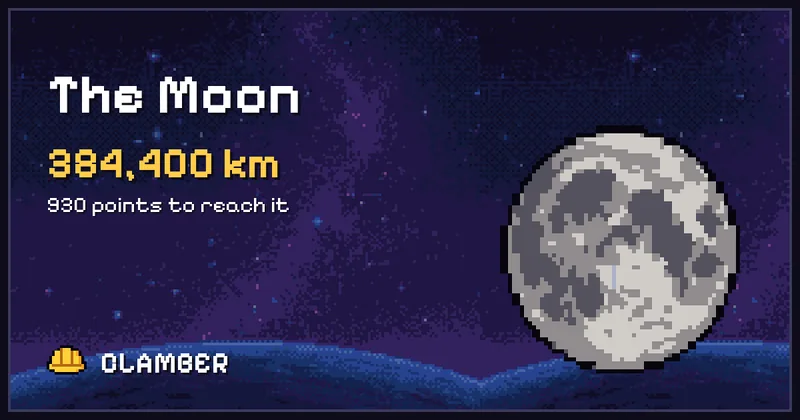
The Moon is 930 points. You need at least six 100-point Rarest answers — and only if one of them lands on the tenth hold, the Summit Push — with every other hold scoring Rare (70). Ten Rare answers get you to 735, just past the GPS satellites (698) and short of geostationary orbit (758).
The point math
| Answer mix | Calculation | Total | Moon? |
|---|---|---|---|
| 6 Rarest (incl. Summit) + 4 Rare | 5×100 + 150 + 4×70 | 930 | Yes |
| 7 Rarest + 3 Rare (Summit Rare) | 7×100 + 2×70 + 105 | 945 | Yes |
| 6 Rarest + 4 Rare (Summit Rare) | 6×100 + 3×70 + 105 | 915 | No |
| 5 Rarest (incl. Summit) + 5 Rare | 4×100 + 150 + 5×70 | 900 | No |
| 10 Rare | 9×70 + 105 | 735 | No |
| Perfect day: 10 Rarest | 9×100 + 150 | 1050 | Yes |
Two lessons fall out of the table. First, Rare is not enough on its own: the gap between 70 and 100 is what the Moon is made of. Second, save your best idea for hold ten if you can — a Rarest there is worth 150, which is why six top answers can be enough. Skipping a hold costs you the whole 70–100, so a safe answer late in the timer always beats a blank.
The ladder: what each score reaches
| # | Landmark | Height | Points | Min. holds at 100 |
|---|---|---|---|---|
| 1 | Statue of Liberty | 93 m | 23 | 1 |
| 2 | Great Pyramid of Giza | 139 m | 37 | 1 |
| 3 | Eiffel Tower | 330 m | 65 | 1 |
| 4 | Empire State Building | 443 m | 84 | 1 |
| 5 | Burj Khalifa | 828 m | 116 | 2 |
| 6 | Fair-weather clouds | 2.0 km | 163 | 2 |
| 7 | Mount Kilimanjaro | 5.9 km | 223 | 3 |
| 8 | Mount Everest | 8.8 km | 265 | 3 |
| 9 | Airliner cruising altitude | 11 km | 302 | 4 |
| 10 | Concorde's cruise | 18 km | 349 | 4 |
| 11 | Highest skydive | 41 km | 405 | 5 |
| 12 | Kármán line | 100 km | 465 | 5 |
| 13 | Gagarin's orbit | 327 km | 525 | 6 |
| 14 | International Space Station | 408 km | 558 | 6 |
| 15 | Hubble Space Telescope | 540 km | 591 | 6 |
| 16 | Inner Van Allen belt | 1,000 km | 618 | 7 |
| 17 | One Earth stacked | 12,742 km | 665 | 7 |
| 18 | GPS satellites | 20,200 km | 698 | 7 |
| 19 | Geostationary orbit | 35,786 km | 758 | 8 |
| 20 | Halfway to the Moon | 192,200 km | 851 | 9 |
| 21 | The Moon | 384,400 km | 930 | 10 |
The ladder is logarithmic after the first rungs: each extra point covers more real distance the higher you go, which is why the last hundred points stretch from geostationary orbit to the Moon. The four Endless-only stops beyond the Moon are on Clamber landmarks.
A 40-second routine for every hold
- Seconds 0–5: let the first answers come — and set them aside. They are almost always Crowd or Common.
- Seconds 5–30: pick one angle and stay on it: a region, a decade, a subtype, an exception, a hobby you know well. The official guide's four moves are neighbours, exceptions, hobbies and “another world” (the same category somewhere unfamiliar).
- Seconds 30–40: if nothing rare has surfaced, type a solid Known or Uncommon answer. 25–45 points beats a skip by the full amount.
Then read the prompt type before you spend effort. Catalogue prompts (stars, rocks, species) hide dozens of 100s; narrow prompts (one band's songs) may hide two. Today's hints show how roomy each prompt's Rarest tier is without giving answers away, and the scoring page explains how tiers are set.

Sources
- Clamber guide — The ladder to the Moon — checked 2026-11-19
- Clamber guide — Find rare answers — checked 2026-11-19
- Clamber — How to play — checked 2026-11-19
- Clamber — Landmarks — checked 2026-11-19
Updated 19 November 2026